
The 2026 3rd International Conference on Environmental Protection and Pollution Control
(EPPC 2026) Successfully Concludes in Qingdao
On September 12, 2026, the 2026 3rd International Conference on Environmental Protection and Pollution Control (EPPC 2026) was successfully held in Qingdao, China. Hosted by Qingdao University of Technology with the support of Universiti Teknologi Malaysia, the conference brought together experts and scholars from universities and research institutions in China and abroad to exchange the latest research findings and technological advances in environmental protection, water resources management, pollution control, and related interdisciplinary fields, while exploring innovative approaches to environmental governance and sustainable development.

Group Photo
At the opening ceremony, Prof. Yihua Xiao, Vice Dean of the School of Environmental and Municipal Engineering at Qingdao University of Technology and Technical Program Committee Chair of EPPC 2026, delivered the opening address. She expressed her hope that the conference would further strengthen exchanges and cooperation among universities, research institutions, and scholars worldwide, and promote advances in environmental protection and pollution control through scientific research and technological innovation.

Prof. Yihua Xiao, Qingdao University of Technology

Prof. Bo Jiang, Qingdao University of Technology
The keynote session was then chaired by Prof. Bo Jiang from Qingdao University of Technology. Prof. Xinyong Li from Dalian University of Technology delivered a keynote speech entitled “Rational Design of Carbon and Spinel Derived Catalytic Material towards Sustainable Applications,” sharing recent research advances in carbon-based and spinel-derived functional materials for energy conversion and green catalysis.

Prof. Xinyong Li, Dalian University of Technology
Prof. Dapeng Li from Suzhou University of Science and Technology presented “Smart Monitoring Technology of Underwater Habitat in Tai Lake—Taking Fish as an Example,” introducing an intelligent monitoring system for underwater habitats in Tai Lake and its applications in aquatic ecological research.

Prof. Dapeng Li, Suzhou University of Science and Technology
Prof. Ming Zeng from Tianjin University of Science and Technology delivered a presentation entitled “Macro and Micro Explorations of AI-Empowered Nitrogen Removal by Anaerobic Ammonium Oxidation Bacteria in Water Bodies,” highlighting the integration of artificial intelligence and multiscale research approaches in biological nitrogen removal from wastewater.

Prof. Ming Zeng, Tianjin University of Science and Technology
Prof. Sheng-Qi Guo from Hebei University of Technology presented “Defect-Induced Defects and Asymmetric Activation: Toward Construction of Efficient Photocatalytic Systems for Water Purification,” sharing recent advances in defect engineering and high-efficiency photocatalytic systems for water pollution control.

Prof. Sheng-Qi Guo, Hebei University of Technology
The afternoon oral presentation session was chaired by Prof. Qingjian Zhang from Qingdao University of Technology. Young scholars from Bauman Moscow State Technical University, University of South China, Taiyuan University of Technology, and other universities and research institutions presented their latest research on pollution control, resource recovery and utilization, ecological monitoring, green energy, artificial intelligence, and related topics, further enriching the academic exchange at the conference.
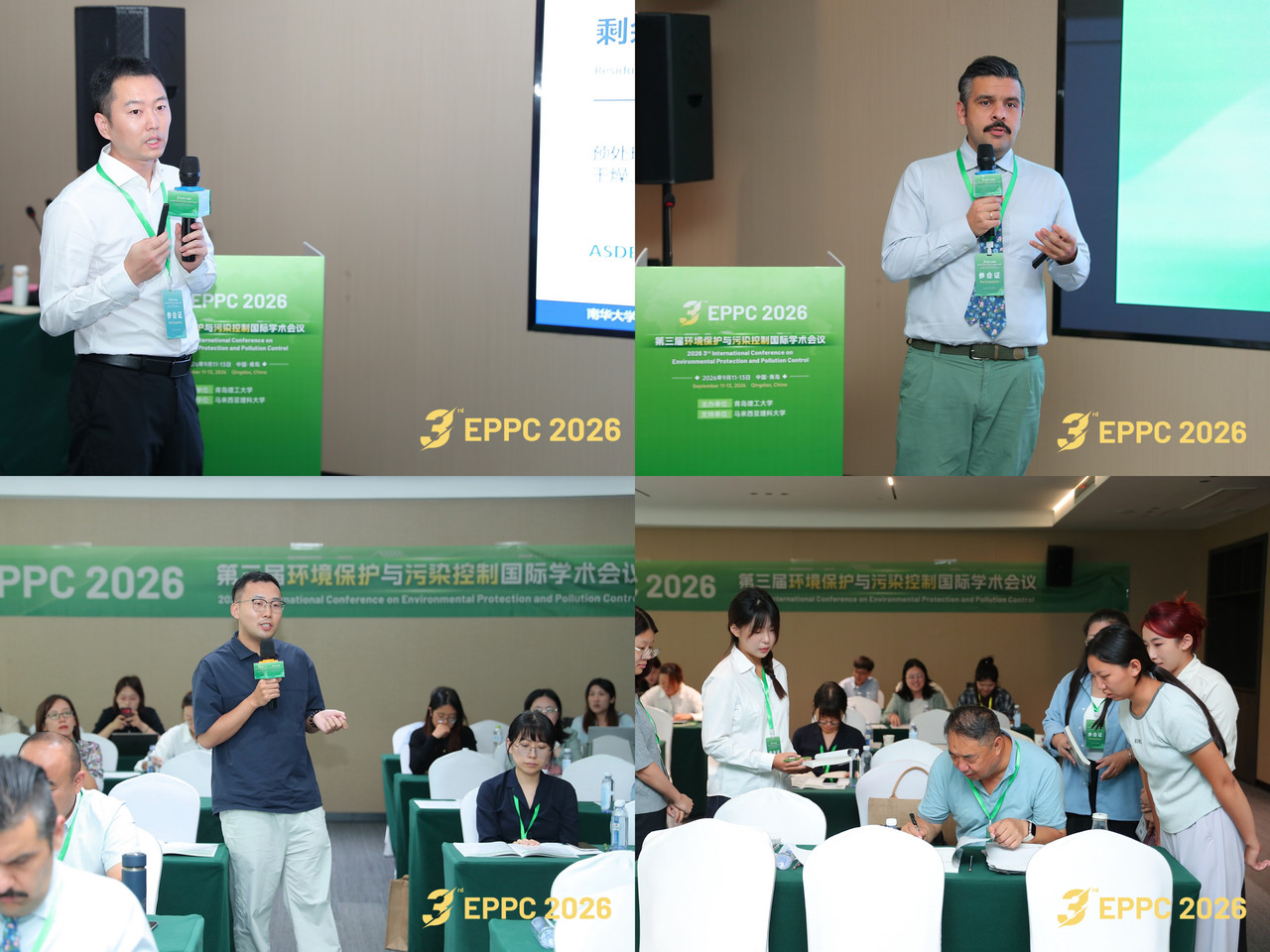
Oral Presentation
EPPC 2026 facilitated in-depth discussions on key scientific issues and technological innovations in environmental protection and pollution control, while promoting the exchange of ideas and academic collaboration across different research areas. The successful conclusion of EPPC 2026 provided an open and diverse platform for scholars in the environmental field worldwide, contributing new academic insights and innovative approaches to pollution prevention and control, ecological and environmental protection, and sustainable development.